
Charles Spencer King |
|---|
«Идея состояла в том, чтобы объединить комфорт и качество хода седана Rover с внедорожными возможностями Land Rover. — говорит Кинг. — В то время никто этого не делал. Я думал, что стоило попробовать, кроме того, Land Rover требовался новый продукт».
Работа над первым прототипом Range Rover, тогда называвшимся «100-дюймовым универсалом», началась в 1966 г., частично под впечатлением от растущего рынка полноприводных автомобилей для отдыха в Северной Америке.
«Он должен был стать премиум-автомобилем для отдыха, но не «люксовым» вариантом, — говорит бывший ведущий конструктор Джеф Миллер (Jeff Miller). Также предполагалось, что в нем будет множество технических новинок.
Спен был убежден, что в автомобиле должны были использоваться винтовые пружины на передней и задней подвеске для комфортного движения по трассе, чего не было ни в одном другом полноприводном автомобиле.
Требовалась пружинная подвеска с очень длинным ходом для удобства при движении по бездорожью».
Среди других технических нововведений были алюминиевый кузов (как у Land Rover), полностью алюминиевый двигатель и дисковые тормоза на всех колесах.
До выхода с конвейера в Солихалле первого серийного автомобиля было произведено всего 10 прототипов.
Само название Range Rover было придумано дизайнером Тони Пулом после того, как были отвергнуты другие названия, включая Panther и Leopard.
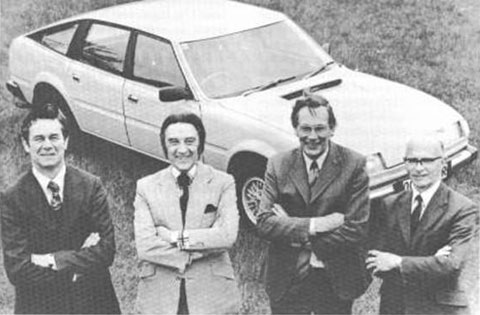
Mike Lewis -Chief Engineer David Bache -Head of Styling Spen King-Director of Engineering Gordon Bahford-sd1 design |
|---|
Mike Lewis - Chief Engineer
David Bache - Head of Styling
Frank Shaw - transmission
Gordon Bashford -chassis, sd1 design
Joe Drinkwater -engine
Sam Ostler - body design.
Olaf Poppe - Chief Production Engineer, Chassis
Robert Boyle - chief engineer at Rover, Chief Engineer at Morris
Mr John L. Cullen - development driver
Tom Barton
Charles Spencer King, 1925-2010
One of the the British engineering industry’s biggest characters and the “father” of the Range Rover, Charles Spencer “Spen” King, died in June, from injuries sustained when his bicycle collided with a van a fortnight earlier.
King was head of new vehicle projects at Rover from 1959, a role in which he oversaw some of the most popular cars of the era including the Rover 2000 and SD1, as well as the Triumph 2000 Mk2, Stag and TR7.
Graham Robson writes ‘an appreciation’:
It would make a good exam question:
‘Two famous engineers. Spen King and Alec Issigonis – compare and contrast.’
It wouldn’t take me long to write the answer: Issigonis liked to be famous, while Spen King shied away from publicity. Yet Spen could do almost everything – and he was also an accomplished, instinctive, stylist!
Britain’s motor industry watchers had known all about ‘Spen’ King for many years before he took over from Harry Webster at Triumph. By then he had already been connected with Rover (latterly British Leyland) for 25 years, his list of ‘credits’ including the still-secret Range Rover.
If Spen hadn’t proved himself to be a engineering genius, cynics might have said that he was lucky. As far as an engineering career was concerned, if there wasn’t a silver spoon in his mouth when he was born, it was close, for Surrey-born Charles Spencer King’s mother was the sister of Spencer and Maurice Wilks.
Spencer Wilks directed Rover’s fortunes from 1929 to 1960. His brother Maurice was Rover’s chief engineer from 1931 until 1957, later managing director, and chairman. That’s some family history ! Not that Spen ever needed a family connection to make his name. After being apprenticed to Rolls-Royce at Derby (during the Second World War), he rapidly got involved in pioneering gas-turbine aero-engine work. Joining Rover in 1946 (along with Frank Bell) he then concentrated on gas-turbine engine, and car, design and development work until the mid-1950s. A brave driver, he drove the first Rover turbine car, JET1, at 152mph in Belgium in 1952:
Not only the engine and the concept, but (along with Gordon Bashford) the advanced chassis layout of the rear-engined 4WD T3 turbine car was also to his credit – he did that one in the evenings, while recovering from a broken leg sustained in a skiing accident:
‘We did the T3 with no budget at all,’ he reminded me, ‘ but it ruined our social lives for a time.’
From 1959 he then headed Rover’s technical forward planning team, finalising the P6 2000 model, installed the light-alloy vee-8 engine in many different cars, and designed two attractive Rover prototypes – the mid-engined P6BS coupe and the big ‘Grosser’ P8 passenger car. Then he conceived the magnificent Range Rover.
Although Spen always insisted that he was happier designing new cars then running a management team, steady promotions eventually forced him to become a manager. Drafted in by British Leyland to be Triumph’s technical director in 1968 (at short notice, to replace Harry Webster, who had gone to Austin-Rover), he then presided over the birth of cars as diverse as the Dolomite, the Triumph 2000 Mk II/2.5PI range, Stag, TR7 and TR8.
He then became technical supremo of the merged Rover-Triumph business in 1972, which meant that he was also responsible for the big Rover SD1 (which really replaced the last of the 2000s), before heading Leyland Cars’ entire technical operation in the mid 1970s. From 1979 he became BL Technology’s Deputy Director, and eventually Chairman, before retiring in 1986. For years after that, still ridiculously active in spite of his advancing years, he was still consulting with various engineering companies in the Midlands, and was resisting any suggestion that he should retire. Busy too – when I invited him to Triumph’s glittering 75th Anniversary dinner in 1998, he turned me down because he was already booked to join a ‘whale watching’ cruise off the coast of Alaska!
Need I even emphasise, too, that he was an absolute gentleman. Interviews might be given only reluctantly, but were then lengthy, courteous and always free of artifice. To listen – and one had to listen -and to hear Spen explaining why Triumph’s 2000/TR6-type independent rear suspension was deficient, was to receive a persuasive technical lecture. But was I surprised by this thoughtfulness ? No, I was not – but then, I admired Spen, and everything he represented, for a very long time….
| Внедорожные транспортные средства (Land Locomotion – Mechanical Vehicle Mobility LL-MVM) Home |